The Problem
You've read every paper. You've implemented attention, multi-head splits, positional encodings, encoder and decoder blocks, BERT and GPT losses, MoE, KV cache. Now make them work together on a real task.
The capstone: train a small decoder-only transformer end-to-end on a character-level language modeling task. It reads Shakespeare. It generates new Shakespeare. It is small enough to train on a laptop in under 10 minutes. It is correct enough that swapping in a bigger dataset and longer training gets you a real LM.
This is the "nanoGPT" of the course. It is not original — Karpathy's 2023 nanoGPT tutorial is the reference implementation every student writes at least once. We lift the shape and retool it around what we've covered.
The Concept
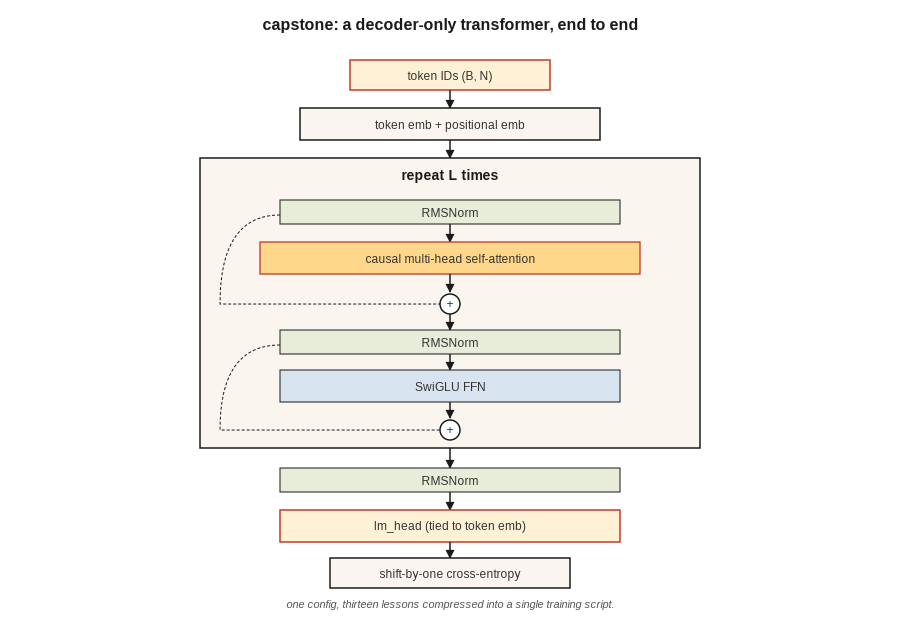
The architecture, annotated:
input tokens (B, N)
   │
   ▼
token embedding + positional embedding  ◀── Lesson 04 (RoPE option)
   │
   ▼
┌──── block × L ────────────────────┐
│  RMSNorm                          │  ◀── Lesson 05
│  MultiHeadAttention (causal)      │  ◀── Lesson 03 + 07 (causal mask)
│  residual                         │
│  RMSNorm                          │
│  SwiGLU FFN                       │  ◀── Lesson 05
│  residual                         │
└────────────────────────────────── ┘
   │
   ▼
final RMSNorm
   │
   ▼
lm_head (tied to token embedding)
   │
   ▼
logits (B, N, V)
   │
   ▼
shift-by-one cross-entropy            ◀── Lesson 07
What we ship
GPTConfig— one place to configure all hyperparameters.MultiHeadAttention— causal, batched, with optional Flash-style pathway (PyTorch'sscaled_dot_product_attention).SwiGLUFFN— modern FFN.Block— pre-norm, residual-wrapped attention + FFN.GPT— embeddings, stacked blocks, LM head, generate().- Training loop with AdamW, cosine LR, gradient clipping.
- Char-level tokenizer on Shakespeare text.
What we don't ship
- RoPE — implemented conceptually in Lesson 04. Here we use learned positional embeddings for simplicity. The exercises ask you to swap in RoPE.
- KV cache during generation — each generation step recomputes attention over the full prefix. Slower but simpler. The exercises ask you to add a KV cache.
- Flash Attention — PyTorch 2.0+ auto-dispatches if the inputs match; we use
F.scaled_dot_product_attention. - MoE — single FFN per block. You saw MoE in Lesson 11.
Target metrics
On a Mac M2 laptop, a 4-layer, 4-head, d_model=128 GPT trained for 2,000 steps on tinyshakespeare.txt:
- Training loss converges from ~4.2 (random) to ~1.5 in about 6 minutes.
- Sampled output looks Shakespeare-shaped: archaic words, line breaks, proper names like "ROMEO:" emerge.
- Val loss (held-out final 10% of text) tracks training loss closely; no overfitting at this size/budget.
Interactive figure coming later.
Build It
This lesson uses PyTorch. Install torch (CPU build is fine). See code/main.py. The script handles:
- Downloading
tinyshakespeare.txtif missing (or reading a local copy). - Byte-level char tokenizer.
- Train/val split at 90/10.
- Training loop with bf16 autocast on supported hardware.
- Sampling after training completes.
Step 1: data
text = open("tinyshakespeare.txt").read()
chars = sorted(set(text))
stoi = {c: i for i, c in enumerate(chars)}
itos = {i: c for c, i in stoi.items()}
encode = lambda s: [stoi[c] for c in s]
decode = lambda xs: "".join(itos[x] for x in xs)
65 unique characters. Tiny vocabulary. Fits a 4-byte vocab_size. No BPE, no tokenizer drama.
Step 2: model
See code/main.py. The block is textbook from Lesson 05 — pre-norm, RMSNorm, SwiGLU, causal MHA. Parameter count for 4/4/128: ~800K.
Step 3: training loop
Get a random batch of length-256 token windows. Forward. Shift-by-one cross-entropy. Backward. AdamW step. Log. Repeat.
for step in range(max_steps):
    x, y = get_batch("train")
    logits = model(x)
    loss = F.cross_entropy(logits.view(-1, vocab_size), y.view(-1))
    loss.backward()
    torch.nn.utils.clip_grad_norm_(model.parameters(), 1.0)
    opt.step()
    opt.zero_grad()
Step 4: sample
Given a prompt, repeatedly forward, sample from top-p logits, append, and continue. Stop after 500 tokens.
Step 5: read the output
After 2,000 steps:
ROMEO:
Away and mild will not thy friend, that thou shalt wit:
The chief that well shame and hath been his friends,
...
Not Shakespeare. But Shakespeare-shaped. A clear win for ~800K parameters and 6 minutes on a laptop.
Use It
This capstone is a reference architecture. Three extensions to ship it to something real:
- Swap the tokenizer. Use BPE (e.g.
tiktoken.get_encoding("cl100k_base")). Vocab size jumps from 65 to ~50,000. Model capacity needs to scale up to compensate. - Train on a bigger corpus. Use
OpenWebTextorfineweb-edu(HuggingFace). 10B tokens on a single A100 takes ~24 hours for a 125M-param GPT. - Add RoPE + KV cache + Flash Attention. The exercises below walk you through each.
This ends up as a 125M-parameter GPT that generates fluent English. Not a frontier model. But the same code path — just bigger — is what Karpathy, EleutherAI, and the Allen Institute use to train research checkpoints in 2026.
Ship It
See outputs/skill-transformer-review.md. The skill reviews a transformer-from-scratch implementation for correctness across all 13 prior lessons.
Exercises
- Easy. Run
code/main.py. Verify your trained model's final-step validation loss is under 2.0. Changemax_stepsfrom 2,000 to 5,000 — does val loss keep improving? - Medium. Replace learned positional embeddings with RoPE. Apply the rotation to Q and K inside
MultiHeadAttention. Train and verify val loss is at least as low. - Medium. Implement a KV cache in the sampling loop. Generate 500 tokens with and without cache. Wall-clock should improve by 5–20× on a laptop.
- Hard. Add a second head to the model that predicts the next-plus-one token (MTP — Multi-Token Prediction from DeepSeek-V3). Train jointly. Does it help?
- Hard. Replace the single FFN per block with a 4-expert MoE. Router + top-2 routing. See how val loss changes at matched active parameters.
Key Terms
| Term | What people say | What it actually means |
|---|---|---|
| nanoGPT | "Karpathy's tutorial repo" | Minimal decoder-only transformer training code, ~300 LOC; the canonical reference. |
| tinyshakespeare | "The standard toy corpus" | ~1.1 MB of text; every character-LM tutorial since 2015 uses it. |
| Tied embeddings | "Share input/output matrix" | LM head weight = transpose of token embedding matrix; saves parameters, improves quality. |
| bf16 autocast | "Training precision trick" | Run forward/back in bf16, keep optimizer state in fp32; standard since 2021. |
| Gradient clipping | "Stops spikes" | Cap global grad norm at 1.0; prevents training blowups. |
| Cosine LR schedule | "The 2020+ default" | LR ramps up linearly (warmup) then decays cosine-shaped to 10% of peak. |
| MFU | "Model FLOP Utilization" | Achieved FLOPs / theoretical peak; 40% dense, 30% MoE is strong in 2026. |
| Val loss | "Held-out loss" | Cross-entropy on data the model never saw; overfit detector. |
Further Reading
- The Annotated Transformer (Harvard NLP) — the classic annotated implementation.
Code
main.py
python phases/07-transformers-deep-dive/14-build-a-transformer-capstone/code/main.pyOpen on GitHub ↗
Take-away files
skill-transformer-review.md
---
name: transformer-review
description: Review a transformer-from-scratch implementation against the 13 Phase 7 lessons.
version: 1.0.0
phase: 7
lesson: 14
tags: [transformers, review, capstone]
---

Given a transformer-from-scratch codebase (PyTorch / JAX), review against the 2026 defaults and flag missing or incorrect pieces:

1. Attention. Causal mask present. Scale by `sqrt(d_head)`. Multi-head split works. Flash Attention used if available. GQA mentioned if d_model ≥ 1024.
2. Positional encoding. RoPE (preferred 2026) or learned absolute (acceptable for small models). Flag sinusoidal as historical.
3. Block wiring. Pre-norm (not post-norm). RMSNorm (not LayerNorm). SwiGLU FFN (not ReLU/GELU). Residuals around every sublayer. Biases dropped in linear layers (modern default).
4. Training. AdamW (or Muon for 2026+), cosine LR schedule with linear warmup, gradient clipping at 1.0, bf16 autocast. Weight tying between token embedding and lm_head.
5. Loss. Shift-by-one cross-entropy at every position. Mask out padding if any. Log train and val loss at a fixed interval.

Refuse to sign off on a codebase with any of: post-norm without explicit reason, LayerNorm in 2026 production code without justification, missing causal mask in decoder self-attention, untied embeddings in a small LM. Flag: no validation split, no gradient clipping, LR > 1e-3 without warmup, or a block_size that exceeds positional embedding range without fallback. Recommend running `python code/main.py` end-to-end and checking final val loss lands under 2.5 on tinyshakespeare at nano config.