The Problem
You have 5 seconds of audio: dog barks, someone yells "stop!", then silence. Useful questions span multiple axes:
- Transcription. "What was said?" — ASR territory.
- Semantic reasoning. "Is the person in danger?" — requires joint understanding of the bark + yell + silence.
- Music reasoning. "What instruments play the melody?"
- Long-audio retrieval. "Where in this 90-minute lecture did the instructor explain gradient descent?"
A single model that answers all of these with one prompt is an audio-language model (LALM / ALM). Separate from pure ASR: LALMs produce free-form natural-language answers, not just transcripts.
The Concept
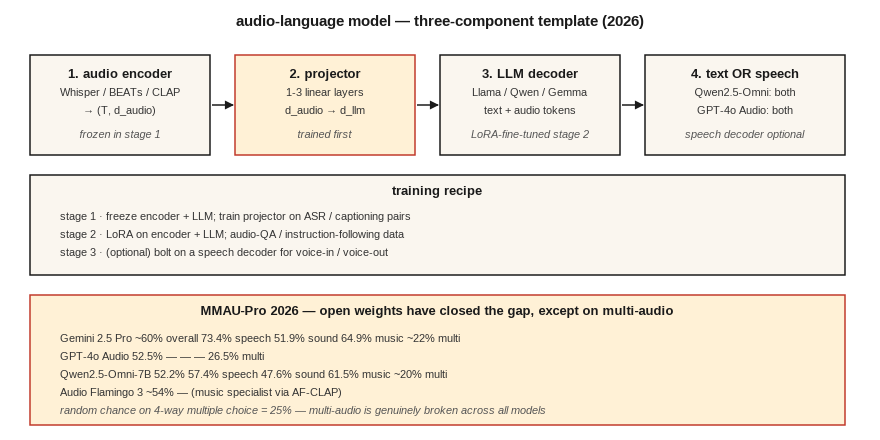
The three-component template
Every 2026 LALM has the same skeleton:
- Audio encoder. Whisper encoder · BEATs · CLAP · WavLM · or a custom encoder per model.
- Projector. Linear or MLP bridging audio-encoder features into the LLM's token embedding space.
- LLM. Llama / Qwen / Gemma-based decoder. Takes interleaved text + audio tokens; generates text.
Training:
- Stage 1. Freeze encoder + LLM; train projector only on ASR / captioning data.
- Stage 2. Full / LoRA fine-tune on instruction-following audio tasks (QA, reasoning, music understanding).
- Stage 3 (optional). Voice-in / voice-out adds a speech decoder. Qwen2.5-Omni and AF3-Chat do this.
The 2026 model map
| Model | Backbone | Audio encoder | Output modality | Access |
|---|---|---|---|---|
| Qwen2.5-Omni-7B | Qwen2.5-7B | Custom + Whisper | text + speech | Apache-2.0 |
| Qwen3-Omni | Qwen3 | Custom | text + speech | Apache-2.0 |
| Audio Flamingo 3 | Qwen2 | AF-CLAP | text | NVIDIA non-commercial |
| Audio Flamingo Next | Qwen2 | AF-CLAP v2 | text | NVIDIA non-commercial |
| SALMONN | Vicuna | Whisper + BEATs | text | Apache-2.0 |
| LTU / LTU-AS | Llama | CAV-MAE | text | Apache-2.0 |
| GAMA | Llama | AST + Q-Former | text | Apache-2.0 |
| Gemini 2.5 Flash/Pro (closed) | Gemini | proprietary | text + speech | API |
| GPT-4o Audio (closed) | GPT-4o | proprietary | text + speech | API |
Benchmark reality check (2026)
MMAU-Pro. 1800 QA pairs covering speech / sound / music / mixed. Multi-audio subset included.
| Model | Overall | Speech | Sound | Music | Multi-audio |
|---|---|---|---|---|---|
| Gemini 2.5 Pro | ~60% | 73.4% | 51.9% | 64.9% | ~22% |
| Gemini 2.5 Flash | ~57% | 73.4% | 50.5% | 64.9% | 21.2% |
| GPT-4o Audio | 52.5% | — | — | — | 26.5% |
| Qwen2.5-Omni-7B | 52.2% | 57.4% | 47.6% | 61.5% | ~20% |
| Audio Flamingo 3 | ~54% | — | — | — | — |
| Audio Flamingo Next | SOTA on LongAudioBench | — | — | — | — |
The multi-audio column is damning for everyone. Random chance on 4-option multiple choice = 25%; most models score around there. LALMs still struggle to compare two clips.
Where LALMs are useful in 2026
- Compliance audit of call-center recordings. "Did the agent mention the required disclosure?"
- Accessibility. Describe sound events to deaf users (not just transcription).
- Content moderation. Detect violent language + threatening tone + background context.
- Podcast / meeting chaptering. Semantic summary, not just speaker turns.
- Music catalog analysis. "Find all tracks with a B-section key change."
Where they are NOT (yet) useful
- Fine-grained music theory (below chord-level).
- Speaker-attributed reasoning over long conversations (degrades past 10 minutes).
- Multi-audio comparison (22-26% is barely above random).
- Real-time streaming reasoning (most are offline batch inference).
Interactive figure coming later.
Build It
Step 1: query Qwen2.5-Omni
from transformers import AutoModelForCausalLM, AutoProcessor

processor = AutoProcessor.from_pretrained("Qwen/Qwen2.5-Omni-7B")
model = AutoModelForCausalLM.from_pretrained("Qwen/Qwen2.5-Omni-7B", torch_dtype="auto")

audio, sr = load_wav("clip.wav", sr=16000)
messages = [{
    "role": "user",
    "content": [
        {"type": "audio", "audio": audio},
        {"type": "text", "text": "What sounds do you hear, and what's happening?"},
    ],
}]
inputs = processor.apply_chat_template(messages, tokenize=True, return_tensors="pt")
output = model.generate(**inputs, max_new_tokens=200)
print(processor.decode(output[0], skip_special_tokens=True))
Step 2: the projector pattern
import torch.nn as nn

class AudioProjector(nn.Module):
    def __init__(self, audio_dim=1280, llm_dim=4096):
        super().__init__()
        self.down = nn.Linear(audio_dim, llm_dim)
        self.act = nn.GELU()
        self.up = nn.Linear(llm_dim, llm_dim)

    def forward(self, audio_features):
        return self.up(self.act(self.down(audio_features)))
That's it. The projector is usually 1-3 linear layers. Training it on ASR pairs (audio → transcript) is the Stage-1 pretext task.
Step 3: benchmarking MMAU / LongAudioBench
from datasets import load_dataset
mmau = load_dataset("gamma-lab-umd/MMAU-Pro", split="test")
mcq = mmau.filter(lambda item: len(item["choices"] or []) > 1)

correct = 0
for item in mcq:
    answer = call_model(item["audio_path"], item["question"], item["choices"])
    if answer == item["answer"]:
        correct += 1
print(f"Accuracy: {correct / len(mcq):.3f}")
audio_path points into the dataset repo's data.zip (about 47 GB), so download and unzip it before scoring. This exact-match loop is a sanity check, not the benchmark scorer, so its number is not comparable with published MMAU-Pro results. The official evaluator matches multiple-choice answers by embedding similarity (NV-Embed-v2), grades open-ended answers with an LLM judge, and checks instruction-following answers with regex rules: write predictions to a model_output column and run evaluate_mmau_pro_comprehensive.py from the MMAU-Pro repo. Report each category (speech, sound, music, multi, and the rest) separately. Aggregate numbers hide where the model fails.
Use It
| Task | 2026 pick |
|---|---|
| Free-form audio QA (open) | Qwen2.5-Omni-7B |
| Best open on long audio | Audio Flamingo Next |
| Best closed | Gemini 2.5 Pro |
| Voice-in / voice-out agent | Qwen2.5-Omni or GPT-4o Audio |
| Music reasoning | Audio Flamingo 3 or 2 (music-specialized AF-CLAP) |
| Call-center audit | Gemini 2.5 Pro via API, with RAG over your policy docs |
Pitfalls
- Over-trust on multi-audio. If your task needs "which clip has X," random-chance-level performance is real.
- Long-audio degradation. Past 10 minutes, most models' speaker attribution breaks. Diarize first (Lesson 6), then summarize.
- Hallucinations on silence. Same Whisper-style issue inherited by LALMs that use Whisper encoder. VAD-gate.
- Benchmark cherry-picking. Vendor blog posts highlight best-case categories. Run MMAU-Pro multi-audio subset yourself.
Ship It
Save as outputs/skill-alm-picker.md. Pick LALM + benchmark subset + output-modality (text vs speech) for a given audio-understanding task.
Exercises
- Easy. Run
code/main.pyto see a toy projector pattern + fake LALM routing of (audio-embedding, text-tokens) → output tokens. - Medium. Score Qwen2.5-Omni-7B on 100 MMAU-Pro speech items. Compare to the paper's reported number.
- Hard. Build a minimal audio-captioning baseline: BEATs encoder + 2-layer projector + frozen Llama-3.2-1B. Fine-tune only the projector on AudioCaps. Compare to SALMONN on Clotho-AQA.
Key Terms
| Term | What people say | What it actually means |
|---|---|---|
| LALM | Audio ChatGPT | Audio encoder + projector + LLM decoder. |
| Projector | Adapter | Small MLP mapping audio features into LLM embedding space. |
| MMAU | The benchmark | 10k audio-QA pairs across speech, sound, music. |
| MMAU-Pro | Harder MMAU | 1800 multi-audio / reasoning-heavy questions. |
| LongAudioBench | Long-form eval | Multi-minute clips with semantic queries. |
| Voice-in / voice-out | Speech-native | Model ingests speech and emits speech without text detour. |
Further Reading
- Chu et al. (2024). Qwen2-Audio — reference architecture.
- Alibaba (2025). Qwen2.5-Omni — speech-in-speech-out.
- NVIDIA (2025). Audio Flamingo 3 — the open long-audio leader.
- NVIDIA (2026). Audio Flamingo Next — LongAudioBench SOTA.
- Tang et al. (2023). SALMONN — dual-encoder pioneer.
- MMAU-Pro leaderboard — live 2026 rankings.
Code
Take-away files
skill-alm-picker.md
---
name: alm-picker
description: Pick an audio-language model, benchmark subset, output modality (text vs speech), and guardrails for an audio-understanding task.
version: 1.0.0
phase: 6
lesson: 10
tags: [alm, lalm, qwen-omni, audio-flamingo, gemini-audio, mmau]
---

Given the task (speech / sound / music / multi-audio / long-audio, output modality, latency, license), output:

1. Model. Qwen2.5-Omni-7B · Qwen3-Omni · SALMONN · Audio Flamingo 3 · AF-Next · LTU · GAMA · Gemini 2.5 Pro (API) · GPT-4o Audio (API). One-sentence reason.
2. Benchmark subset to validate. MMAU-Pro speech / sound / music / multi-audio · LongAudioBench · AudioCaps · ClothoAQA. Pick the axis that matches the user task.
3. Output modality. Text-only · text + speech (Qwen-Omni, GPT-4o Audio). Budget for an additional speech decoder if needed.
4. Guardrails. Reject prompts that require multi-audio comparison when your model's multi-audio score is < 30% (near-random). Diarize before LALM for > 10-minute inputs.
5. Escalation. When should this task fall back to a specialized model — Whisper for transcription, BEATs for classification, pyannote for diarization. LALM is not the best of each.

Refuse to ship multi-audio comparison tasks without verifying your model scores > 40% on the MMAU-Pro multi-audio subset. Refuse long-audio (> 10 min) without upstream diarization. Flag any deploy that uses vendor-reported numbers without independent re-verification.

Example input: "Compliance audit: transcribe 10-minute bank-call recordings + detect if the agent read the mandatory disclosure."

Example output:
- Model: Whisper-large-v3-turbo for transcription + Gemini 2.5 Pro (via API) for disclosure-check QA over the transcript. LALM direct on raw audio is tempting but long-audio LALM accuracy drops past 10 min.
- Benchmark subset: MMAU-Pro speech subset (Gemini 2.5 Pro = 73.4%) — covers the speech-reasoning axis. Also spot-check on your own 50-call gold set.
- Output modality: text-only. Speech output not needed for an audit report.
- Guardrails: diarize with pyannote 3.1 first; send per-speaker segments separately; log confidence score per call.
- Escalation: if a call fails the disclosure check, route to human reviewer instead of autonomous flag.