The Document Extraction Pipeline taught me a lot about building resilient async systems. FastAPI + Celery + Redis handled OCR and LLM extraction at scale, with retries, job queues, and error handling. But when I started building real-time LLM APIs for the DeepAgent project, I realized document processing resilience wasn't enough.
The difference? In document processing, you're batch-oriented and can retry. In LLM APIs, you're real-time and can't afford to fail.
This post shows how to evolve your async patterns from "it eventually works" to "it never breaks user experience."
Case Study Foundation: Document Extraction Pipeline
Let's recap the resilience patterns already working in production:
# From Document Extraction Pipeline
def extract_document_task(self, document_id: str, schema: str):
    """Celery task with built-in retry."""
    try:
        document = fetch_document(document_id)
        ocr_result = run_mineru_ocr(document)

        # LLM extraction with provider retry
        for attempt in range(3):
            try:
                result = call_llm_provider(ocr_result, schema)
                return result
            except LLMProviderError as e:
                if attempt == 2:
                    raise
                time.sleep(2 ** attempt)  # Exponential backoff

    except Exception as exc:
        # Celery handles retry with countdown
        raise self.retry(exc=exc, countdown=60)
What this handles:
- ✅ Transient OCR failures
- ✅ LLM provider timeouts (3 attempts)
- ✅ Exponential backoff between retries
- ✅ Job persistence via Redis
What's missing for pure LLM APIs:
- ❌ Circuit breakers (keeps hitting failing provider)
- ❌ Multi-provider fallback (single point of failure)
- ❌ Real-time rate limiting (429 errors)
- ❌ Latency-aware routing
Extending to LLM-Specific Resilience
The Problem: 99.5% Uptime Isn't Enough
Cloud infrastructure promises 99.9% uptime. LLM providers run at 99-99.5%. That's 6-14x worse reliability—and when your entire product depends on LLM calls, that 0.5% downtime kills user trust.
Real scenario from DeepAgent:
- 2 PM: OpenAI API throws 503 errors
- 2:01 PM: Users see 30-second timeouts
- 2:05 PM: Queue backs up, Redis memory spikes
- 2:10 PM: Cascade failure, entire system down
Circuit breakers and multi-provider fallbacks prevent this.
The Resilience Stack
Four layers:
- Exponential backoff + jitter - Handle transient failures
- Circuit breaker - Stop hitting failing providers
- Dual rate limiting - Client-side + provider limits
- Multi-provider fallback - Route around outages
Implementing Exponential Backoff
Celery has built-in retry, but for real-time LLM calls, you need more control:
import random
import time
from functools import wraps
from typing import Callable, TypeVar

T = TypeVar('T')

def exponential_backoff(
    max_retries: int = 3,
    base_delay: float = 1.0,
    max_delay: float = 60.0,
    exceptions: tuple = (Exception,)
):
    """Decorator for exponential backoff with jitter."""
    def decorator(func: Callable[..., T]) -> Callable[..., T]:
        @wraps(func)
        def wrapper(*args, **kwargs) -> T:
            for attempt in range(max_retries + 1):
                try:
                    return func(*args, **kwargs)
                except exceptions as e:
                    if attempt == max_retries:
                        raise

                    # Exponential backoff + full jitter
                    delay = min(base_delay * (2 ** attempt), max_delay)
                    jitter = random.uniform(0, delay)

                    # Log for monitoring
                    print(f"Attempt {attempt + 1} failed: {e}. Retrying in {jitter:.2f}s...")
                    time.sleep(jitter)

            raise RuntimeError("Unreachable")
        return wrapper
    return decorator

# Usage for LLM calls
@exponential_backoff(
    max_retries=3,
    base_delay=1.0,
    exceptions=(LLMProviderError, TimeoutError)
)
def call_openai_with_retry(prompt: str) -> str:
    return openai_client.chat.completions.create(
        model="gpt-4",
        messages=[{"role": "user", "content": prompt}]
    )
Handling different error codes:
def classify_error(error: Exception) -> str:
    """Classify errors for appropriate handling."""
    if isinstance(error, RateLimitError):  # 429
        return "rate_limited"  # Longer backoff
    elif isinstance(error, ServiceUnavailableError):  # 503
        return "transient"  # Standard retry
    elif isinstance(error, AuthenticationError):  # 401
        return "fatal"  # Don't retry
    elif isinstance(error, BadRequestError):  # 400
        return "client_error"  # Don't retry
    else:
        return "unknown"  # Conservative retry
Circuit Breaker Pattern for LLMs
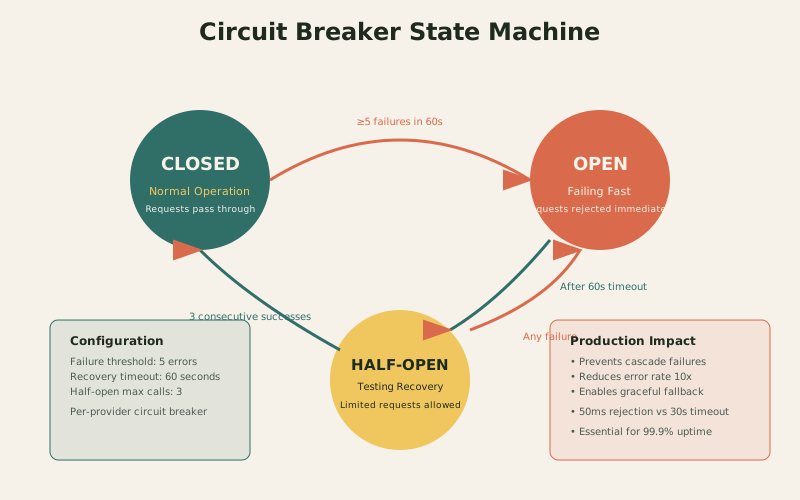
When an LLM provider is down, stop trying. The circuit breaker has three states:

Implementation:
import time
from enum import Enum
from dataclasses import dataclass
from typing import Optional

class CircuitState(Enum):
    CLOSED = "closed"      # Normal operation
    OPEN = "open"          # Failing, reject fast
    HALF_OPEN = "half_open"  # Testing recovery

@dataclass
class CircuitBreaker:
    failure_threshold: int = 5
    recovery_timeout: float = 60.0
    half_open_max_calls: int = 3

    def __post_init__(self):
        self.state = CircuitState.CLOSED
        self.failure_count = 0
        self.last_failure_time: Optional[float] = None
        self.half_open_calls = 0

    def call(self, func, *args, **kwargs):
        """Execute function with circuit breaker protection."""

        if self.state == CircuitState.OPEN:
            if time.time() - self.last_failure_time > self.recovery_timeout:
                self.state = CircuitState.HALF_OPEN
                self.half_open_calls = 0
            else:
                raise CircuitBreakerOpenError("Circuit breaker is OPEN")

        try:
            result = func(*args, **kwargs)
            self._on_success()
            return result
        except Exception as e:
            self._on_failure()
            raise

    def _on_success(self):
        if self.state == CircuitState.HALF_OPEN:
            self.half_open_calls += 1
            if self.half_open_calls >= self.half_open_max_calls:
                self.state = CircuitState.CLOSED
                self.failure_count = 0
        else:
            self.failure_count = 0

    def _on_failure(self):
        self.failure_count += 1
        self.last_failure_time = time.time()

        if self.state == CircuitState.HALF_OPEN:
            self.state = CircuitState.OPEN
        elif self.failure_count >= self.failure_threshold:
            self.state = CircuitState.OPEN

# FastAPI middleware integration
circuit_breakers = {
    "openai": CircuitBreaker(failure_threshold=5, recovery_timeout=60),
    "anthropic": CircuitBreaker(failure_threshold=5, recovery_timeout=60),
    "ollama": CircuitBreaker(failure_threshold=3, recovery_timeout=30),
}

def call_with_circuit_breaker(provider: str, func, *args, **kwargs):
    breaker = circuit_breakers.get(provider)
    if not breaker:
        return func(*args, **kwargs)
    return breaker.call(func, *args, **kwargs)
Multi-Provider Fallback Strategy
When OpenAI fails, try Claude. When Claude fails, use local Ollama.

Implementation:
from dataclasses import dataclass
from typing import List, Optional, Callable
import time

@dataclass
class ProviderConfig:
    name: str
    client: Callable
    priority: int  # Lower = higher priority
    cost_per_1k: float
    max_latency: float  # Max acceptable latency

class MultiProviderRouter:
    def __init__(self, providers: List[ProviderConfig]):
        self.providers = sorted(providers, key=lambda p: p.priority)
        self.latency_tracker = {}

    async def generate_with_fallback(self, prompt: str) -> str:
        """Try providers in priority order with circuit breaker awareness."""

        for provider in self.providers:
            # Skip if circuit breaker is open
            breaker = circuit_breakers.get(provider.name)
            if breaker and breaker.state == CircuitState.OPEN:
                continue

            # Check latency history
            avg_latency = self.latency_tracker.get(provider.name, 0)
            if avg_latency > provider.max_latency:
                continue

            start = time.time()
            try:
                result = await call_with_circuit_breaker(
                    provider.name,
                    provider.client,
                    prompt
                )

                # Track latency
                self.latency_tracker[provider.name] = time.time() - start

                return {
                    "result": result,
                    "provider": provider.name,
                    "latency": self.latency_tracker[provider.name]
                }

            except Exception as e:
                print(f"Provider {provider.name} failed: {e}")
                continue

        raise AllProvidersFailedError("All LLM providers unavailable")

# Configuration
providers = [
    ProviderConfig("openai", openai_client, priority=1, cost_per_1k=0.03, max_latency=5.0),
    ProviderConfig("anthropic", anthropic_client, priority=2, cost_per_1k=0.03, max_latency=5.0),
    ProviderConfig("ollama", ollama_client, priority=3, cost_per_1k=0, max_latency=10.0),
]

router = MultiProviderRouter(providers)
Cost implications:
- Fallback to Claude: Same cost tier (~$0.03/1K tokens)
- Fallback to Ollama: $0 but slower (local GPU)
- Always monitor: Set alerts if >10% traffic hitting fallback
Token Bucket Rate Limiting
Prevent 429 errors by enforcing client-side limits.

Redis-based implementation (leveraging existing Redis from Document Pipeline):
import time
from dataclasses import dataclass

@dataclass
class RateLimitConfig:
    requests_per_minute: int = 60
    burst_size: int = 10  # Allow burst of 10

class TokenBucketRateLimiter:
    def __init__(self, redis_client, config: RateLimitConfig):
        self.redis = redis_client
        self.config = config

    async def is_allowed(self, key: str) -> bool:
        """Check if request is allowed under rate limit."""
        now = time.time()
        bucket_key = f"rate_limit:{key}"

        # Lua script for atomic operation
        lua_script = """
        local key = KEYS[1]
        local now = tonumber(ARGV[1])
        local window = tonumber(ARGV[2])
        local limit = tonumber(ARGV[3])
        local burst = tonumber(ARGV[4])

        -- Get current tokens and last update
        local data = redis.call('HMGET', key, 'tokens', 'last_update')
        local tokens = tonumber(data[1]) or burst
        local last_update = tonumber(data[2]) or now

        -- Add tokens based on time passed
        local time_passed = now - last_update
        local tokens_to_add = time_passed * (limit / window)
        tokens = math.min(burst, tokens + tokens_to_add)

        -- Check if request allowed
        if tokens >= 1 then
            tokens = tokens - 1
            redis.call('HMSET', key, 'tokens', tokens, 'last_update', now)
            redis.call('EXPIRE', key, window)
            return 1
        else
            redis.call('HSET', key, 'last_update', now)
            redis.call('EXPIRE', key, window)
            return 0
        end
        """

        allowed = await self.redis.eval(
            lua_script,
            1,  # num keys
            bucket_key,
            now,
            60,  # window in seconds
            self.config.requests_per_minute,
            self.config.burst_size
        )

        return bool(allowed)

# Per-user rate limiting in FastAPI
@app.post("/generate")
async def generate(
    request: Request,
    body: GenerateRequest,
    limiter: TokenBucketRateLimiter = Depends(get_limiter)
):
    user_id = get_user_id_from_token(request)

    if not await limiter.is_allowed(f"user:{user_id}"):
        raise HTTPException(
            status_code=429,
            detail="Rate limit exceeded. Try again in 60 seconds."
        )

    # Process request...
Production Checklist
Before shipping resilient LLM APIs:
- Exponential backoff on all LLM calls
- Circuit breaker per provider (5 errors → 60s cooldown)
- Multi-provider fallback (minimum 2 providers)
- Client-side rate limiting (token bucket)
- Latency-aware routing (track p50/p99 per provider)
- Dead letter queue for failed requests
- Monitoring: circuit breaker state, fallback rate, latency
- Alerts: >5% fallback traffic, circuit breaker open >5min
Lessons from Document Extraction Pipeline Scaling
What translated directly:
- Celery + Redis for job queuing
- Retry with exponential backoff
- Async/await patterns
- Error classification
What needed adaptation:
- Circuit breakers (not needed for batch processing)
- Multi-provider (document pipeline used single LLM provider)
- Real-time rate limiting (batch has natural backpressure)
- Streaming responses (documents are processed whole)
Key insight: Start with Document Extraction Pipeline's patterns, add circuit breakers at month 3, multi-provider fallback at month 6 when you have SLA commitments.
Monitoring Dashboard
Track these metrics in production:
# Prometheus metrics
CIRCUIT_BREAKER_STATE = Gauge('circuit_breaker_state', 'Circuit state', ['provider'])
FALLBACK_RATE = Counter('fallback_total', 'Fallback events', ['from_provider', 'to_provider'])
LATENCY_BY_PROVIDER = Histogram('llm_latency_seconds', 'Latency by provider', ['provider'])
RATE_LIMIT_HITS = Counter('rate_limit_hits_total', 'Rate limit hits', ['user_type'])
Alert thresholds:
- Circuit breaker open > 5 minutes
- Fallback rate > 10% of traffic
- P99 latency > 10 seconds
- Error rate > 1%
Next Steps
This resilience layer sits on top of the architecture from the previous post. In the next post, I'll cover memory management—how to handle context windows in multi-turn conversations without blowing up token costs.
Code examples: GitHub repository (DeepAgent implementation)
Related:
Questions? Email me or connect on LinkedIn.